(Note: This blog was created on July 25, 2019, and this was the first post.)
Day 1: July 8
1.
The first time I travel in some 4 years, and in fact the first time I travel alone, I was going to Okinawa for a short 4-day (3-night) vacation. Today I was impressed by the MRT Airport Line when getting to the airport, and by the electronic, simplified boarding procedure. The Eva Air flight was smooth, and took a little more than 1 hour from Taoyuan to Naha. Upon landing it was incredibly straightforward, given the Kanji obvious in meaning, to figure out how to transfer, by means of local monorail, to the Miebashi Station (美栄橋駅) near where I was to dwell for the next 3 nights. Along the neatly arranged blocks and traffic lights, markedly different from those in Taiwan, I was able to get to the hotel with little effort, by following Google Maps—thanks to the very affordable roaming plan of local mobile company Docomo, about 300 NTD each day in price. The Smile Hotel Okinawa where I stayed, marked 3 stars on Google, was tidy and equipped with most necessities, while only costing about 2-thousand NTD per night.
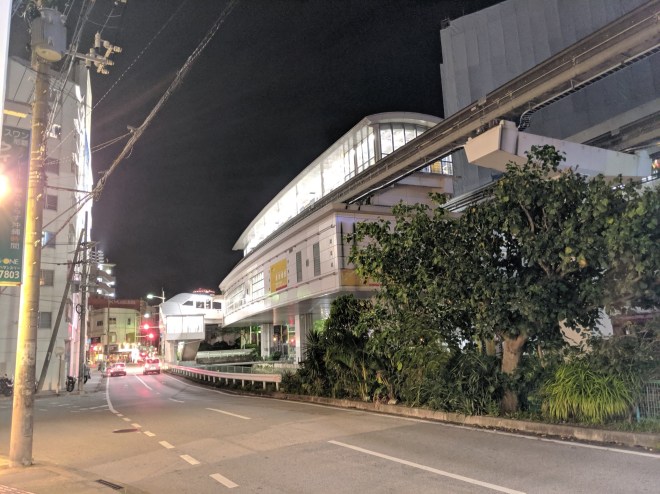
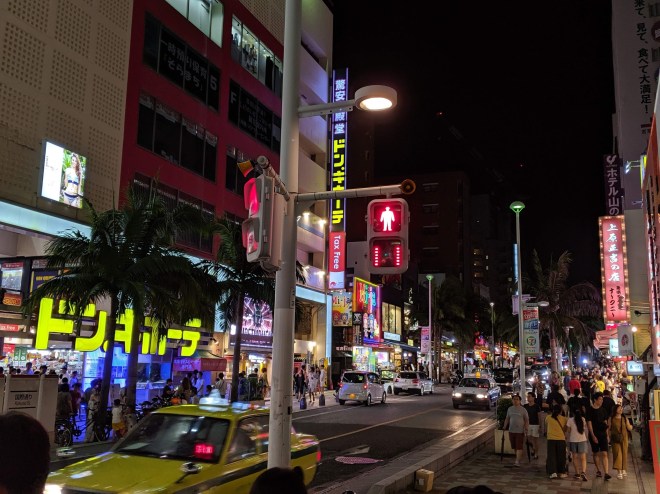
From my hotel I returned to Miebashi Station to meet a friend of mine, Fang-Yi; it was a 20-minute walk. The street was full of Izakaya-bars and Yakiniku-grill restaurants, and of chained retail stores (the most pervasive is “Lawson”) still open late, including the familiar Family-Mart. By 9 o’clock—it was nominally 1 hour later than Taipei here—I saw Fang-Yi by the Station. She came to Okinawa too, together with another friend of ours, Pei-Lin. Though technically staying in Okinawa in the same interval of time, except this evening we were not to meet, for reason totally unnecessary (and uninteresting, I must add) to elaborate. Pei-Lin was in a non-ideal position to have to work to meet the deadline while on a long-planned vacation, whom let us earnestly bless and pass over in silence. Instead let us notice, in front of us, the first place of interest I was to encounter today (but not my friend, who had been a seasoned traveler of Japan)—The International Street (国際通り). From the direction of radiant lights from shop signs, here lay a variety of shops and restaurants.

3.
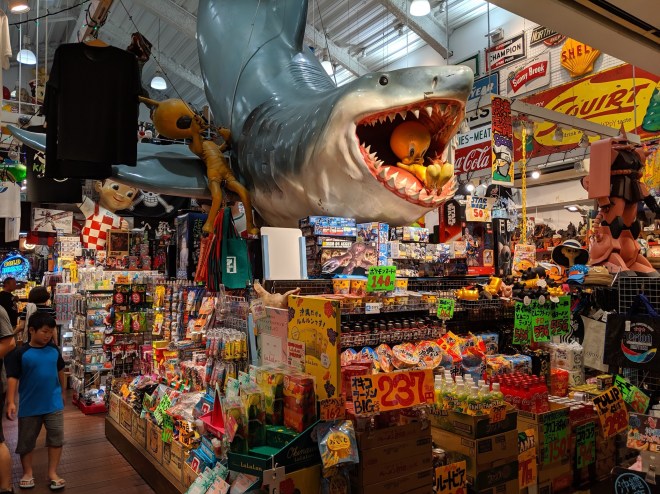
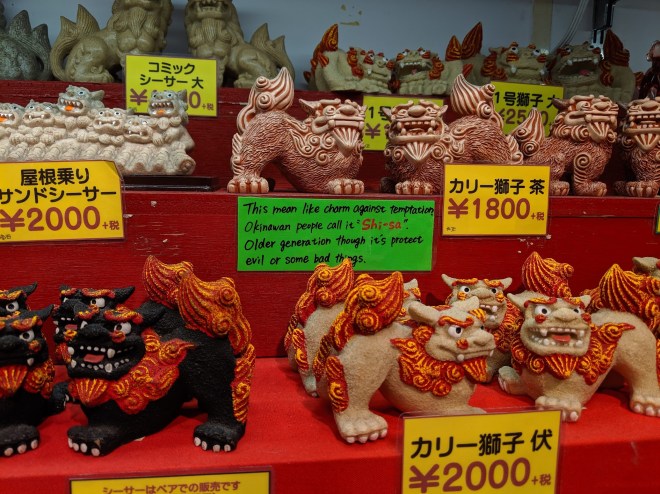
The very first eye catching thing was the glassware, a feature in Okinawa. I purchased a spiral-curved glass cup of deep blue that looked attractive. That was probably because the cup resembled, and was named after, the Blue Cave (青の洞窟), where I was not about going to, since it was too cumbersome, I guess, to swim or snorkel alone, and tiresome too—the very vacation, to me, was meant to relax. I also bought a case of Sablé cookie, made with the featured salt of Chitan (北谷), to treat fellow Lab students, in support of the excuse for the fact that I was absent. Besides food, cosmetic shops were also said to be a must visit, for your information. There were dubiously-looking masks purported to be made in volcano dust, and shampoo containing honey. And Merlion-like lion figures explained on the note in problematic English. What I did not bought: the curious looking Caulerpa lentillifera (海ぶどう), crunchy and rather salty in taste. What I did bought: cheap packs dried seaweed, the chilies dipped in wine (though it turns out I would not be able to pass that in custom), and cured fish. Food made up the most practical gifts.
4.
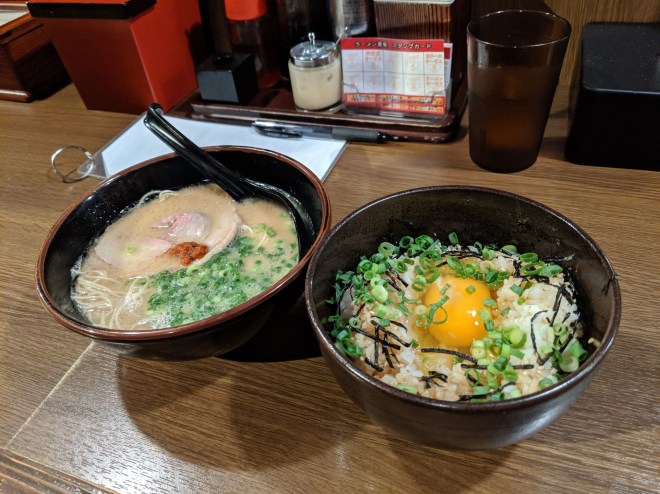
Fang-Yi and I walked westward along the street, and encountered a Ramen shop called “康竜”. I ordered a (I guess) soy-sauce flavored Ramen simply called “Ramen”, served with rice with raw yolk. It was (as was expected) salty, but good. We commented on the nature of Japanese language, as well as other language learning experience—though I was ashamed to admit that I had almost forgotten anything German I had learnt several years ago, and my understanding of Japanese was restricted on Duolingo’s Level-One lessons taken several days ago. I shared a recent enlightenment of personal nature, that, in every language, a sentence is such an entity organized of, let us say, “content words” and “function words”, where function words add redundancy—drawing analogy from study of error correction codes—so that the relationship between content words can be made clear and resist from misreading and mishearing. And Japanese is particularly unusual in this regard, as it adopts two writing systems, Kana and Kanji. Kana’s exhibit inflection (in the wider sense), wile Kanji’s do not (and could not). We talked a lot, and were in good mood. Having gone back to the monorail station I parted my friend, and wished them two well. Since I planned to catch an early bus to yonder Churaumi Aquarium in the north of the tropical island, but had already spent an hour and half writing (only to find my English rusty), I had better sleep now.

 Sketchbook