The liminf and limsup for sets

Liminf and limsup for sets will be used in the proof of Borel-Cantelli Lemma. There are two equivalent definitions on Wikipedia, and it seems weird at first. Namely: liminf (resp. limsup) is defined as union of intersections (intersection of unions), and is also said as occurring infinitely often (occurring for all but finite indices). Let us verify their equivalence.

Let a sequence of sets, A_1, A_2, \dotsc be given. By definition,
\limsup\limits _{n \to \infty} A_n :=\bigcap\limits _{k =1} ^{\infty} \bigcup\limits _{n =k} ^{\infty} A_n … [1]
We claim
\limsup\limits _{n \to \infty} A_n := \bigcap\limits _{k =1} ^{\infty} \{\omega:\; \omega \in A_n \quad \mathrm {infinitely\; often}\} … [2]
By definition of union,
=\bigcap\limits _{k =1} ^{\infty} \{\omega:\; \exists n,\; n \geq k,\; \omega \in A_n\}
By definition of intersection,
=\{\omega:\; \forall k\; \exists n,\; n \geq k,\; \omega \in A_n\} … [3]
The meaning is completely the same as “infinitely often”, as claimed.

Alternatively, we may define
\limsup\limits _{n \to \infty} A_n =: \{\omega: \limsup \mathbf{1}_{\{A_n\}} [x] =1\}

Similarly, suppose
\liminf\limits _{n \to \infty} A_n :=\bigcup\limits _{k =1} ^{\infty} \bigcap\limits _{n =k} ^{\infty} A_n
We claim
= \bigcap\limits _{k =1} ^{\infty} \{\omega:\; \omega \in A_n \quad \mathrm {for\; all\; but\; finitely\; many}\; n\}
By definition of intersection,
=\bigcup\limits _{k =1} ^{\infty} \{\omega:\; \forall n,\; n \geq k,\; \omega \in A_n\}
By definition of union,
=\{\omega:\; \exists k\; \forall n,\; n \geq k,\; \omega \in A_n\}
The meaning is completely the same as “all but finitely many”, as claimed.

Alternatively, we may define
\liminf\limits _{n \to \infty} A_n =: \{\omega: \liminf \mathbf{1}_{\{A_n\}} [x] =1\}

Personal Position Study #02


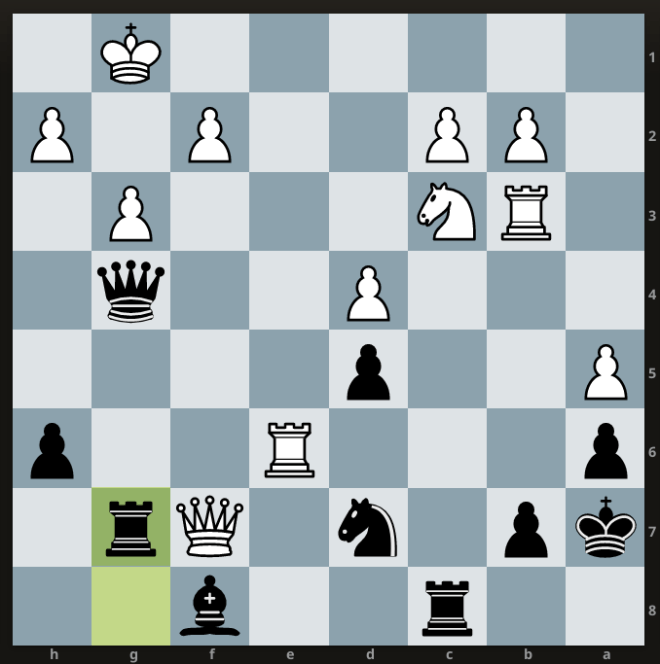
Find the best move for White.

honorbear v. violapterin, Sep. 7, 2019

1. … Rg7
(Fig.)

★ Spoiler alert! See below for the answer. ★

actual-01

The main line is supposed to be the better response. The underlined are the actual continuation in the game.

Now, Black seems to have trapped the white queen … or has he?

2. Rxa6+!

By sacrificing the rook, White have not only saved his queen, but is also unfolding a series of possible attack, as follows.

[2. … Kxa6? 3. Qxd5 Nf6 {responding to 4. Qxb7#}

[(3. …Rc7 4. Rb6+! Nxb6 5. Qb5+ Ka7 6. axb6+ {winning back the rook in no time!} Kb8 7. Qe8+ Qc8 8. Qe5 {pinning the rook} Rg5 9. bxc7+ Qxc7 10. Qe8+ Qc8 11.Qxc8+ Kxc8 ± {White has 4 pawns for the black rook, which is certainly playable.})

[4. Qb5+

[(4. Rb6+ {also possible} Ka7 5. Nb5+ Ka8 6. Ra6+ Kb8 7. Qe5+ Rgc7 8. Nxc7 bxa6 9. Nd5+ Kb7 10. Qxf6± {10. … Bg7? Qb6+. White is threatening mate, or taking the Black bishop, or the pass a-pawn})

[4. … Ka7 5. Qb6+

[(5. … Ka8? 6. Nb5 1-0 {the only way for Black to continue is giving up the bishop: 6. … Bc5 7. dxc5 Qd1+ 8. Kg2 Qd5+ 9. Rf3 Qxc5 10. Rxf6 Qxb6 11. axb6 ± and white is up in material.})

[5. … Kb8 6. Qxf6 Qg5 7. Qe5+ Qxe5 8. dxe5]

While Black has a rook for a knight, White just has too many pawns. Still Black may want to give it a try.

2. … bxa6! 3. Qxd5 Nf6 4. Qe5 ±

Now b5 is guarded, and there is no 4. Qb5+. See what crucial effect it has on the game! The tension is dissolved, and Black retains material.