Quotes from Rise of the Robots

When researching about the issue, Amazon recommends me a book on technological unemployment: Martin Ford, Rise of the Robots: Technology and the Threat of a Jobless Future. Here are some quotes, which are already very unsettling, and I will put more here when I finish the book.

The fact is that “routine” may not be the best word to describe the jobs most likely to be threatened by technology. A more accurate term might be “predictable.” Could another person learn to do your job by studying a detailed record of everything you’ve done in the past? Or could someone become proficient by repeating the tasks you’ve already completed, in the way that a student might take practice tests to prepare for an exam? If so, then there’s a good chance that an algorithm may someday be able to learn to do much, or all, of your job.

The unfortunate reality is that a great many people will do everything right—at least in terms of pursuing higher education and acquiring skills—and yet will still fail to find a solid foothold in the new economy.

Jobs remain the primary mechanism by which purchasing power gets into the hands of consumers. If that mechanism continues to erode, we will face the prospect of having too few viable consumers to continue driving economic growth in our mass-market economy.

An English poetry anthology

This is the syllabus I copied when auditing the course by Prof Tien-En Kao [高天恩] in spring 2013. I hope I will have time to reread these poems, and good poetry definitely rewards those who rereads.

Week 1
Alexander Pope: “Sound and Sense”
Archibald MacLeish: “Ars Poetica”
Adrienne Rich: “Poetry: I”
Week 2
Wilfred Owen: “Dulce et Decorum Est”
Keith Douglas: “Vergissmeinnicht”
Thomas Hardy: “Channel Firing”
Week 3
William Shakespeare: “Winter”
Robert Hayden: “Those Winter Sundays”
Thomas Hardy: “The Darkling Thrush”
Gerard Manley Hopkins: “Spring”
Week 4
William Carlos Williams: “The Widow’s Lament in Springtime”
e.e. Cummings: “in Just__”
William Shakespeare: “Shall I compare thee to a summer’s day?”
Robert Hayden: “The Whipping”
Gwendolyn Brooks: “Kitchenette Building”
Week 5
Langston Hughes: “Cross”, “Dream Deferred”, “Suicide Note”
William Carlos Williams: “The Red Wheelbarrow”
Philip Larkin: “A Study of Reading Habits”, “Toads”
Week 6
Philip Larkin: “Aubade”, “Church Going”
Matthew Arnold: “Dover Beach”
Week 7
Wallace Stevens: “Sunday Morning”
Week 8
A.E. Housman: “Is My Team Plowing?”, “Loveliest of Trees”, “Terence, this is stupid stuff”
Week 10
Sylvia Plath: “Mirror”
Ellen Kay: “Pathedy of Manners”
Adrienne Rich: “Storm Warnings”, “Aunt Jennifer’s Tigers”, “Living in Sin”
Week 11
Linda Pastan: “Ethics”, “To a Daughter Leaving Home”
Elizabeth Bishop: “One Art”, “The Fish”
Week 12
Richard Eberhart: “For a Lamb”
Walt Whitman: “A Noiseless Patient Spider”
Robert Frost: “Bereft”, “Fire and Ice”
Week 13
Frost: “After Apple-Picking”, “Desert Places”, “Design”, “Stopping by Woods on a Snowy Evening”
Week 14
Frost: “Mending Wall”, “Nothing Gold Can Stay”, “The Road Not Taken”, “Out, Out”
Week 15
Seamus Heaney: “The Forge”, “Digging”
Richard Wilbur: “Mind”, “The Writer”
Week 16
William Shakespeare: “That Time of Year”
John Keats: “When I have fears that I may cease to be”, “To Autumn”, “Ode on a Grecian Urn”
Week 17
William Butler Yeats: “When You Are Old”, “The Wild Swans at Coole”, “Sailing to Byzantium”, “The Second Coming”

How media changed the opinion on face masks

May 18
In Feb 2020, some Anglophone media states that face masks hardly helps in keeping us away from virus, or that masks are not as effective as hand washing. This is the reason that, at least for some months, I also doubt whether face masks are effective. No wonder many Americans still refuse to wear them, since a wrong impression can take much longer to forget than to remember.

By now, one year later, it is overwhelmingly agreed that face masks are indispensable. I hereby try to trace how the collective opinions change.

“BBC: Why are people wearing masks and do they work?”

>> Dr Jake Dunning, head of emerging infections and zoonoses at Public Health England, said: “Although there is a perception that the wearing of facemasks may be beneficial, there is in fact very little evidence of widespread benefit from their use outside of these clinical settings.”
>> Dr David Carrington, of St George’s, University of London, seems to agree, telling BBC News that “routine surgical masks for the public are not an effective protection against viruses or bacteria carried in the air,” because they were too loose, had no air filter and left the eyes exposed.

“Forbes: Masks Prevent You From Infecting Others With Coronavirus, But May Not Protect You From Being Infected”

>> First of all, most people buying masks are not getting one that stops the virus from reaching their mouth or nose anyway. The coronavirus is transmitted through droplets, not through the air. That means you cannot randomly breathe it in, but it also means the standard surgical mask you see people wearing will not help. Those masks are designed to keep droplets in—not to keep them out—and are intended to keep the wearer from getting others sick.
>> Not using—or disposing of—a respirator mask correctly can increase infection risk because it is literally trapping all the stuff in the air you’re trying to avoid, and many people end up touching their face absent-mindedly.

“CNN: Should I be wearing a mask?”

>> Tariro Mzezewa, a New York Times travel reporter, tells CNN the measure is not necessary unless you are sick or are interacting with sick people.
>> The US Centers for Disease Control and Prevention does not recommend Americans wear surgical masks in public. Surgical masks are effective against respiratory infections but not airborne infections.

Nanmen Market [by Dini]

[translated Nov 19] The original Nanmen Market [南門市場] is an interesting place, and lately some dear recollections have come to me.

When it comes to the new-year shopping in the “groceries from South to North” [南北貨], Dihua street [迪化街] and Nanmen Market are the prime choices. The retreat to Taiwan back in the Chinese civil war incidentally endowed us dishes in the “eight styles”, and a thorough walk in Nanmen’s does provide a representative if incomplete sample.

Seldom have I bought ingredients from Nanmen’s, after I started cooking myself. A few kinds of supplies I do replenish are dried ingredients — the cured Jinhua ham [金華火腿] for stewing, infant shrimps for frying, infant fish for sauces, and scallop for steamed egg. A slight disappointment is however the lack of Xinjiang pepper as of now, which has a flavor heavy but not excessively spicy. To make a fried cured meat with garlic leaf, which I crave for every year or two, one can’t go wrong with Nanmen’s, or possibly the “Peng’s Hunan Cured Meat” [彭記湖南臘肉].

The stinky tofu, if steamed rather than fried, I tell you, smells ten times worse. If you think it is not strong enough, leave that in room temperature for days to let it ferment, and the softer it is, the more stinky, so much that it can well deserve a quarantine in the balcony. But I stopped buying it upon discovering that it is made from gene-modified soybeans, and later, to avoid extra estrogen in it.

Jinhua ham too is finicky to make, in that, rather unlike the honey-cured ham, it requires more than a year to age. But an old store I frequent has their own bacteria colonies, and even their own factory in Taoyuan that insists on using local Taiwan pork: a principle (which I failed to appreciate before) rare in the time of pig pandemic and in the contending imported US pork.

While Guangdong people love to have ham in steamed soup, hams actually originated in Zhejiang in the Northern Song. Northeastern sour cabbage, equally indispensable in seasoning the hot pot, is another thing: if the salt brings out the sweetness, the sour cabbage rids the oil. Indeed I have once, out of rebelishness, made a sour-cabbage-with-fat-meat pot with leaner pork, and they simply did not go well, and I so realized the wisdom of insisting fat meat passed all along from the ancestors.

But as for cooked food, quite a few highly regard the Yichang Royal House [億長御坊], where I remember a more friendly price before it enjoyed its fame. The sweet-sour ribs and baby fish with chilis have stayed in my childhood memories; after I could cook better, I hardly purchased them any longer. Still there were the Lion’s Head (stewed meatball) and the braised goldfish with green onion, one in Huaiyang style and one in Sichuan style, all so intricate yet meticulous prepared that I can hardly tell the original ingredients by their final look, hence my principle of refraining from eating out was reluctantly compromised, when I fancied them once in a long while.

Just next to the stairs in the basement of Nanmen’s, was a stand of Chouzhou-style Zongzi [潮州粽], which at its best is comparable to Dintaifung’s [鼎泰豐]. Another stand sells some mantou, baozi, among other sweet breads and pastas. (But you have to go up to the second floor for babaofan, a sweet rice with fruits.) Further down the basement were stands of raw foods, such as some ridiculously priced vegetables, and giant pork rib bones, excellent for stew, which are sold out so early in the morning. In the end of hall, before electronic slaughter was popularized by the government, there used to be a stand of raw chicken, and it was there that I have seen chicken slaughtered, blood drained, and hair removed by hot water. The peculiar dark walk therefore cast, for some time, a shadow in my mind when I was a kid.

Jinfeng’s [金峰] Lobahpng [滷肉飯] (rice with minced pork), served there with fried tofu, is something I have favored as a kid, but my taste buds somehow no longer prefer them now. While it has been a tourists’ place of interest, the incredibly long queue always astonishes me. A path near Jinfeng’s leads to a stand of Loumei [滷味] (soy-braised snacks); they know to cure ingredients overnight to let the sauce in. Tofu, chicken wing, chicken leg, and wood-ear are the best in my opinion, but the holder is so good at advertising, you have to “harden your ear” and stand firm in your ground.

P.s. The original Nanmen Market is being remodeled, and has moved into a makeshift building for now.

[Mr Jiang the coder was getting married;]

[Nov 15] I have this series of (objectively boring) events happening today, but they made me happy, and I tell you why. A first friend of mine, Mr Jiang the coder, was getting married; he was a classmate of mine in the EE department, and worked in Google now. 

I was not willing to attend the wedding banquet, because I am afraid of all the small talks on my future plan. But the first message received today saved me; a second friend of mine, Ms Shi the erhu instructor, asked me whether I wanted to go to a concert for free in place of her, as she could not go. She had to attend an awards ceremony.

I nevertheless wanted to send the red envelope to Mr Jiang; so, I handed the envelope physically and left, going to the concert. Then, it occurred to me in the concert, I forgot to mark on the envelope that it was indeed for Mr Jiang, the groom, and the receptionist will not tell. Will he get the money? I was so poorly versed in social conventions that I often chose to be alone.

It was a premiere concert of newly commissioned pieces in Chinese style. Composers stood up to receive applause after their pieces were performed. It struck me another time, seeing this, that I always had wanted to be a composer, an amateur one, yet I lacked the talent and time. I had sometimes pictured that I shall work during the day and compose music at night. And the vision looked so distant and vague, I thought, in the blackness in the concert hall, in front of the spotlight.

The concert ended, and Ms Shi messaged me whether I enjoyed it. “I prefer a more modern style.” I wrote. “Have you been composing music lately?” she asked. (I acquainted her only once at a recital of another common friend of ours, where I said I sometimes compose music.) “Haven’t for some time. Will you help me if I write an erhu piece?” I asked. Sure, she replied, showing genuine interest, and sent me a file which explained erhu’s ability. This cheered me up, so much that I was immediately in a whimsical mood, imagining erhu melodies in my head.

Several years ago, I recalled, I said to a third friend of mine, Ms Wen the flautist, that I will write a flute sonata and ask her to try it out. She studied in Paris at present. Months ago, intending to bring up the matter, I wrote some melodies and messaged them to her, and she didn’t reply.

Then, Mr Jiang messaged me to thank me for my envelope. “I will perhaps ask you, some time, how it is like to work at Google.” I wrote. Anytime, he wrote.

Later, a fourth friend of mine, Ms Huang the pianist, messaged me, remarking that she was getting married (too), and invited me to watch the live stream on YouTube, and Ms Wen, our common friend, was also invited. Amused, I messaged Ms Wen, mentioning the flute sonata. She replied instantly, urging me to complete the piece. I wished to dedicate the piece to her, I wrote, if it will indeed be done. It will be an honor, she wrote, and she had found a piano accompanist.

This was how I, somehow, reconnected four friends, within one day. These were trivial matters, and they made me laugh, in the same way you earnestly believe a flaw to be grave but it may very well be immaterial, or an air to be serious, but be lighthearted, as when a cook gave you eleven meatballs instead of ten, or a stapler failed to penetrate the last page. It was like this I was having this unfounded epiphany on the street, in the rush hour in the evening, in a warm wintry breeze. Things, at least some of the times, are going to be okay. It is a common shortfall of ours to forget happy times when we are sad, which we nevertheless must try — as sad times when happy.

[Cats are undoubtedly adorable, but dogs are more loyal,]

[Oct 27] Dogs and cats are among the most beloved pets. Cats are undoubtedly adorable, but dogs, people say, are more loyal, as they love their owner unconditionally and foolishly, even if the owner beats it or lets it starve, as we sometimes learn in the news.

I have this friend Joan, who now lives by herself, and she wants to have a dog as a company. She had a tense relation with her parents, and she recalled that, this year on her birthday, “my mother wished me a happier life I ought to enjoy in the prime of my life.” She was moved. And later she regretted having been moved.

It reminds me of “Deep-holes”, a short story by Alice Munro. [Spoilers below] There is this son Kent, and the father Alex, a geologist, and the mother Sally. Once as the family went with the father to wildness to collect stone specimens, Kent fell into a cave, and the father helped him out. The kid broke the leg, recovered, and remained slightly but permanently injured. Once, the father said that he saved Kent not due to love, but to familial duty, indicating that they were not close.

When he was in college, Kent disappeared and stopped contact. Years passed, and Alex died. One day, Sally saw on TV that Kent volunteered as a firefighter. She met him, and it turned out he was living a Bohemian lifestyle, together with a community of the homeless, who volunteered to help local people. Kent told her of his anguish, that he derived no joy in helping people, but merely felt that he was obliged to do so.

The question plagued the short story, that why Kent left his parents and desired such a life. I got it when I reread. Because Kent remained feeling indebted to Alex’s favor. The parents are the world of the baby, while the baby is but a negligible bit of the parents. It is terrifying to have been born, if we must suffer such an unfair position.

Or Alex may be God, and Kent be Christ. It is more distressing than fortunate — to continue the allegory — to be saved by Christ, because we ought to “take his yoke upon him and learn from him”, as Christ resolved to be crucified. And what grave responsibility that is.

Thus I am afraid to have a dog. I hug it, I imagine, and it will have the amorous look on my face, yearning and innocent, like I am some immaculate deity. But I am not. I am sinned. It is not that I will not tend it properly. No, I would walk it well, feed it well, “out of duty”, but what if I will not love it, and what if, still, it continues to turn back and gaze at me.

We can do nothing but continue the stifling daily life, by having mercy on those whom we cannot love, and being enslaved by those who do not love. I may not be a father nor a Christian, I gather, but will remain alone, and will not keep a dog.

[My uncle is dying of cancer,]

[Oct 9] My uncle (my mother’s eldest brother) is dying of cancer, and was admitted into palliative care. He and his family live in the US, and I have only seen him twice, therefore I do not feel much sadness, but still there is emptiness which emerges every time I know people is dying. My mother does not appear to be weeping, and I did not bring up the matter.

Meanwhile, I had this stream of consciousness, which unfolded in the following order. (1) A few days ago, I was reading *Simply Nietzsche* by Peter Kail. The first chapter on *The Birth of Tragedy* explains that Nietzsche was answering the pessimism of Schopenhauer’s. Schopenhauer remarked, and rightly so, that our life is essentially no more than suffering, and our existence has no value. Nietzsche responded that it is only through the intoxication in art that may we combine as a unity, in so doing finding the power to overcome the bleak reality. (2) Yesterday, I entered the 校園書房 in front of NTU the first time it finished remodeling, and skimmed one of the displayed book, *The Reason for God* by Timothy Keller. The apologetic book suggests that, since we have a natural tendency to crave for something more than the material world, does it not hint that that immaterial realm may actually exist? Here, I knew religion helps people cope with their short and brutal life; but I was curious how they easily believe in something because they wish it so, without more reasons. (3) Then as I said, last night, I heard my uncle was dying.

And I started imaging how terrifying it is to face death, and recalled that many who in their old age or terminally ill, converted from atheists to believers. In fact, many intelligent people, including Einstein and Grothendieck, became religious in their middle years; what precisely changed them? There was, I recalled, a post on Reddit which asked believers who converted from atheists , what the reason was; so I found the post, and spent some time reading.

I might have realized something. Quite many simply believe what they yearn for exists, when they genuinely yearn for it, and if it does not, they say, they are not worse off. Indeed, why don’t we believe that better world is there, as long as it is not impossible, and the thought makes we feel better? More broadly, why do we believe that our life has value, it is good to help people, what object we pursue will turn out well, and we are not dust when we die?

This is optimism in a certain form, which is hard to blame. Many accept it, when they go through this phase, but not I; it is something I have long rejected. I must myself face the loneliness, depression, anxiety, emptiness, sickness, and death, which I have yet truly tasted, but life will certainly offer me as it does to everyone. What is enough to reassure myself, I am not sure, except perhaps the beauty of music works that remind me of the strength we have, and the sense of connection I feel in creating them, so that I shall linger a little longer on the land of earth, but alas, how evanescent it is, dissolving already into nothingness as the sound dies in the air!

About 6 hours after I posted this on Facebook, he passed away. He was 74, which does not sound particularly old. What makes us sad is that, he was a medical doctor and was attentive of his health, and he was frugal with money and hard working; still, he was suddenly sick (due to a recurring of cancer) about one month just before he retired, and was deprived of the only chance to enjoy more casual days in his advanced age.

Perhaps put more succinctly, my last post raises the question that how we might face life’s predicaments — like depression, loneliness, illness, and death — without the solace of faith. I am not sure I am strong enough to endure such hardship alone (more likely, I am sure I am not), but I have also rejected religions of any sort. Schopenhauer and Nietzsche knew the dilemma, and they claimed that art can have people connected and fill the void deep in our psyche. That said, I doubt that will ever suffice.

A Fan-fiction Version of Eurus’s Song

[Slight spoilers] Just finished Sherlock Season 4, Episode 3, The Final Problem. The characterization of Eurus Holmes is haunting. (See Baker Street Wiki: The Musgrave Ritual)

But it seems to me Eurus’s Song is not entirely satisfying. As pointed out, the tune is based on Go Tell Aunt Rhody, which I find catchy. But the lyrics is not shown in its entirety in the show, and it is not properly rhymed and does not fit the meter. Moreover, the cypher is purportedly based on the dates on the gravestone of the Holmes graveyard, and, though it is not fully spelled out, the deciphering can seem arbitrary.

Thus, I decided to write my own fan-fiction poem and propose a simple cypher. I wrote that within about 3 hours. Some of the images are inspired by the lyrics proper, and those of Go Tell Aunt Rhody.

O by the stream, look, mother goose
At last does at one gosling weep.
In shadows will want she a noose;
Of course, my friend, care not her sleep.

Do kids forlorn, save someone sober,
Her favorite tree tend, which grows wild?
Her feathers fall ere this October;
Her laughter will doom that sane child.

O breeze, pray not mind youngsters cunning;
Your breathing rids, kin to the mills,
The blood beside lone rivers running,
One mile around there where it kills.

Do East Winds gay come to the flowers,
And siblings too play as they bath?
And does the goose find that for hours
Her babies make room for their death?

I do intend my poem to be as creepy as possible, and I hope that I did it. Actually, the Go Tell Aunt Rhody already reads creepy enough, and so are many Mother Goose tales, no wonder Agatha Christie was inspired of And Then There Were None.

If read by every four words, my poem yields:

O look at one in want of care,
Do save and tend her, ere her doom.
O mind your kin, the lone one there,
Do come and play and find her room.

This fits the rest of the story, where the plain text reveals to Sherlock that Eurus has been lonely, and indicates him to come to her room (of young Eurus’s).

My poem can fit the tune of Go Tell Aunt Rhody, though one has to read 2nd and 3rd syllables in one beat, and it probably works better when just being read out according to iambic tetrameter.

Götterdämmerung

Abstract: I review a performance of Twilight of the Gods, commenting in roughly such order: on listening experience, music interpretation, staging and design, and Wagner’s composition itself as a drama and a piece of music.

This production of Twilight of the Gods (Götterdämmerung) is conducted by Shao-Chia Lü (呂紹嘉), and directed by Carlus Padrissa. Brünnhilde is played by Rachel Nicholls, Siegfried by Lance Ryan, Hagen by Andrea Silvestrelli, Gunter by Lauri Vasar, Gutrune by Sandra Trattnigg. According to the credit, it is originally staged by La Fura Dels Baus.

It was the Oct 4 performance, in National Taichung Theater, that I attended. It was the first time I entered this lofty modernistic building, having opened about exactly 3 years ago. One walked in the middle of huge curved pillars, and came up several set of stairs to get to the big hall where the performance was to take place. There, a large orchestra pit could be accommodated, which the National Concert Hall couldn’t do. There were medium- and small-halls too. Indeed, just now there was a listening guide (presenter called 呂岱衛), holding in the medium hall that had started at about 16:00, which I joined. The talk was very helpful. We were given free brochures, which summarized the plot and verbal description (but without score examples) of leitmotifs.

Act 1 lasted from 17:15 to 19: 10; Act 2 from 19:45 to 20:45; Act 3 from 21:10 to 22:30. In the two long intermissions, stands were selling absurdly expensive light food, but hungry people still bought that, myself included. When it ended, I was fearing that I could not catch the train to Taipei, but I managed to stay for another 10 minutes to give stand ovation, for applauding was more important. But I took a taxi, and caught the last train successfully, thus making perfect use of today’s schedule.

Before this, I kind of thought Wagner to be dry, and even hypnotic, and so I was not a big fan of his. This time I decided to gave it a try, out of curiosity to see in person what a full-fledged Ring production would be like. Moreover, this Spanish team had collaborated with the opera house for 4 years in a row, and it was to be the last one in the cycle. The Ring was not something commonly performed in entirety, and the next time can mean forever. So I went to the concert.

And I do not regret it at all! My prejudice against Wagner dispels, and I think he is meant to be watched, which seems so obvious in retrospect!

The orchestra accompaniment is of high quality: overall the music flows smoothly, and very little mistake is made. Somehow the interpretation is more controlled than agitated, but I am not sure. I am seated in the principal hall, level with the stage, with ticket priced 3 000 NTD, at the point one-third the width to the right wall, and one-third the depth to the back wall. The acoustic experience is really great, and I am also close enough to see the actor’s facial expression. When one has listened to a real, full-sized orchestra, recordings pales in comparison. Tubas, timpani, and double bassoons are particularly grandiose to hear in real time.

The singers are impressive too. Apart from daunting register and sheer volume that Wagner demands, the roles of Siegfried and Brünnhilde call for a youthful vividness. Siegfried’s voice part is especially challenging. There are piano passages which involves notes as high as A_4, and his highest note throughout the work (I recall) is C_5! And when he is to die, and kneels and lies face-down on the floor, calling Brünnhilde’s name, Siegfried even sings as effortlessly as usual. This being said, Hagen’s voice is particularly sonorous, while being somehow coarse (but not displeasingly so), which strangely suits the sinister character of his. Though Siegfried and Brünnhilde are extraordinary enough to compete with the orchestra, the resounding voice of Hagen’s still overwhelms theirs.

On the other hand, the stage and costume design are eccentric. First, the costume is in the science fiction style. That apart, there are more obscure symbolism all over the place, like numbers in Chinese characters, and a big \pi (as big as his chest) printed on the back of Gunther’s coat—No, I didn’t expect the LaTeX feature of WordPress will come in handy in this music review. Everybody wears western suits, except for the quasi-primitive outfit Siegfried wears in the very beginning, and the incongruity can be odd.

Most of the time, the stage is empty (except perhaps for tables and chairs), and the surroundings are hinted only by image projection. The minimalism policy in costumes and props works okay, but it probably was not what Wagner expected, considering that the composer built a cutting edge theater to make his lavish production possible.

The minimalism can be too much, for example, in the last dramatic event, that Hagen should have been devoured into the River Rhine to death. This is not shown directly, but instead, Hagen (or another one?) rides on a electronic unicycle and falls onto the ground. (To be sure, it is difficult to tell what’s happening in the midst of a swarm of acrobats.)

The director also incorporates some acrobat performance, which is not a bad thing, but it is unfortunate that the acrobats’ endeavor can’t be integrated more effectively to the main part of the story. In end of act 1, purported nudes (in skin-colored bodysuit) appear and wiggle on the rock where Brünnhilde resides, when Siegfried, disguised as Gunther, swears by the sword that he will not touch Brünnhilde. So what do the nudes signify? They can’t mean the lust Siegfried has for Brünnhilde, which he has none after drinking the love potion. Similarly in the end of act 2 these entertainers make virtuoso jumps in the supposed realm of gods, not sure what that signify. In the end of Act 3, acrobat performers, hung like flying trapeze, again impressively circles around Siegfried’s dead body, which is said to be the building of Valhalla on the brochure. (I guess it is due to ease of arrangement, that they always introduce acrobats in the concluding section only.) At least the positive thing (not being sarcastic) is that they make good use of the vertical visual room in this spacious hall.

In addition to acrobats, the director is trying very hard to prevent audiences from sleeping, by projecting animation on the screen, when purely instrumental interludes are playing. It shows, e.g., the sea Siegfried is in, when he goes on his adventures in Act 2. So, though it turns out really hard to feel sleepy, animation can be a bit ludicrous, given the serious nature of the drama.

Finally on the composition itself. To begin, the plot of the whole Ring cycle is actually rather well arranged. There are interlocking action out of love and hatred, loyalty and betrayal, making characters well-rounded and complicated. And introduction of physical devices (e.g. the ring and helmet) and character relation often foreshadows later development.

It is so heartbreaking that, in the story, if anyone had throw the ominous ring away in any stage, the characters will avoid their doomed fate. Like the moment that the Rhine girls is teasing Siegfried, the composer portrays his reckless character in great precision. Money is nothing to Siegfried, and he is almost to give the ring away when the Rhine girls pledge him so. But when they warn him of the tragic ending he is facing, he ironically determined to keep the ring instead, in rebel to the fate.

Meanwhile, admittedly, there are also some inconsistency in the plot. For example, in the last part of Act 2, surely Gunter does not know the fact that Brünnhilde has been united with Siegfried. But when Brünnhilde says that there is a vulnerable spot on Siegfried’s back, doesn’t Gunter suspect that there is something between them? As another instance, why is Siegfried just about to come to the Gibichungs’ castle, the moment Hagen, Gunther, and Gutrune there finishes the discussion of their evil plan? This is too much a coincidence. But these problems may also have something to do under the limitation of transition of scenes.

As for the music, the heart of Wagner’s success (or failure) is his introduction and use of leitmotifs. In its best, the effect is remarkable and highly satisfying. Like the section that Siegfried recounts his adventure: previous leitmotifs appear, in relevant order, when he describes the people and things, all constructed tightly and organically. Also the very last section that Brünnhilde jumps into the flames to her death, is also a masterpiece; it eloquently reminds us of — and summarizes — the whole franchise, by a series of leitmotifs, collectively suggestive of the theme of destruction and redemption.

So how may Wagner still appear abstruse to some? I guess it is due to fact that his melodies usually lacks distinctive shape. In fact, they are not changed and developed as much as what Beethoven often does to them in his sonatas and symphonies. But they follow leitmotifs rather faithfully — a tremendous constraint. I now remember nothing of the melody, but can’t forget (and can be tired of) the ever-repeating leitmotifs.

And Wagner seldom writes heavy contrapuntal lines, nor introduces rhythmic complexities, leaving the melody subordinating to homophony. I would appreciate if Wagner had written more duets and trios, as in the Ring the parts mainly consist of a single voice. (There is only one section, namely the argument between Gunter, Brünnhilde, and Hagen in the last section of Act 2, as mentioned above, that may be loosely counted as a trio.) In this regard, singers can be considered as  just another music instrument.

Wagner’s harmony is not progressive, if that can be a factor too. One peculiarity of his is the use of the so-called half-diminished 9th chord (e.g., \{B_3, D_4, F_4, A_4, C_5\}). Here the minor ninth is unnatural, and does sounds like avant-garde, but apart from that, he retains a generally classical harmony usage.

Generally, though I am sympathetic to Wagner’s rationale of introducing leitmotifs, I gather that it does not quite work out. Indeed, what Wagner’s idiosyncrasy dismays people (and sometimes me), is precisely what pleases his fans, and what he considered to have been his contribution. And this is probably true to every inventive artist. Wagner is still not my favorite opera composer, but I recognize his effort and praise his ingenuity. Maybe I will grow liking him, maybe not. I do replay other Ring albums on Spotify from time to time, and the more I listen to them, they do seem the less daunting and the more enjoyable.

Solitude Vacation in Okinawa (4/4)

Day 4: July 11

1.

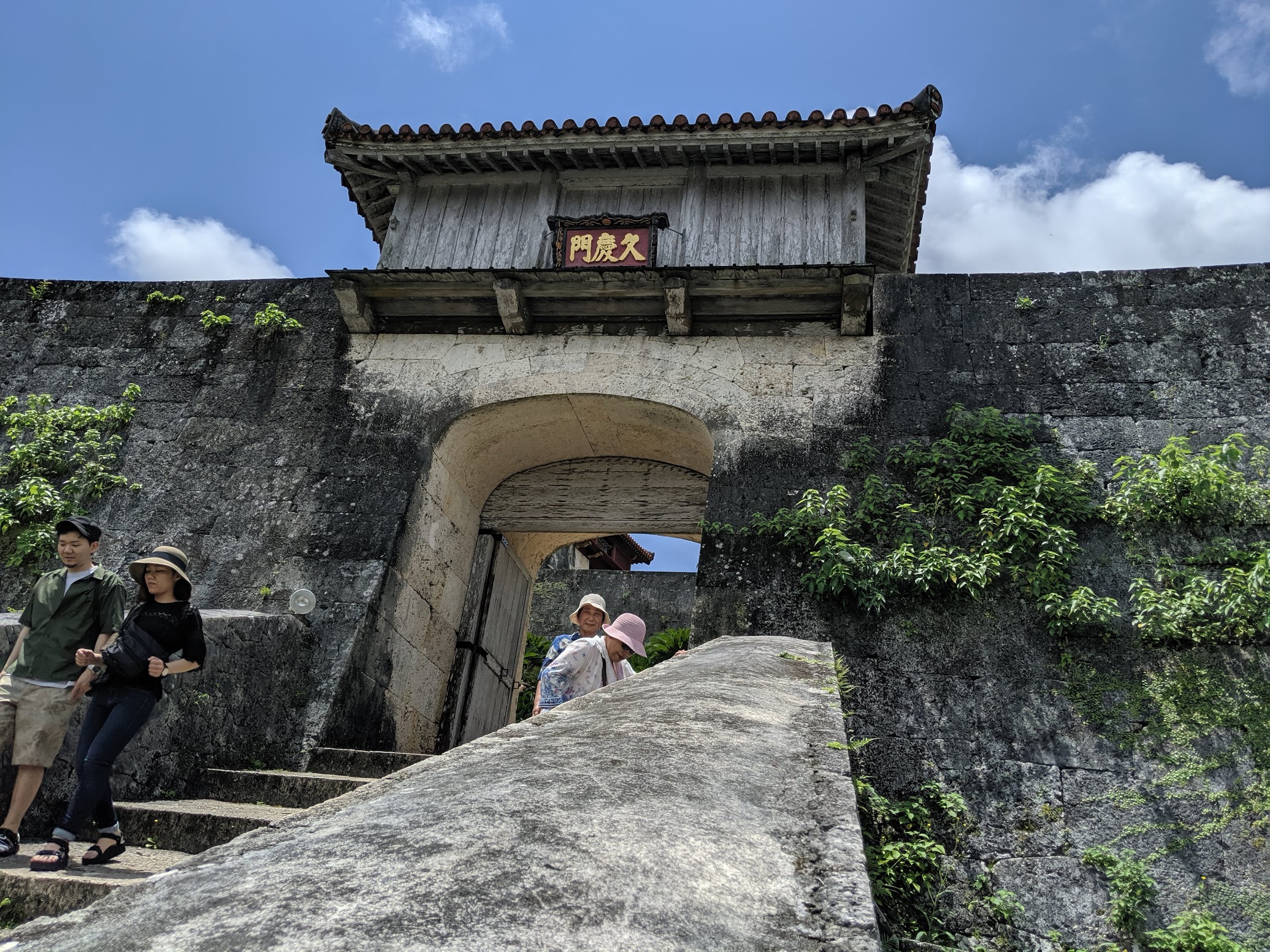
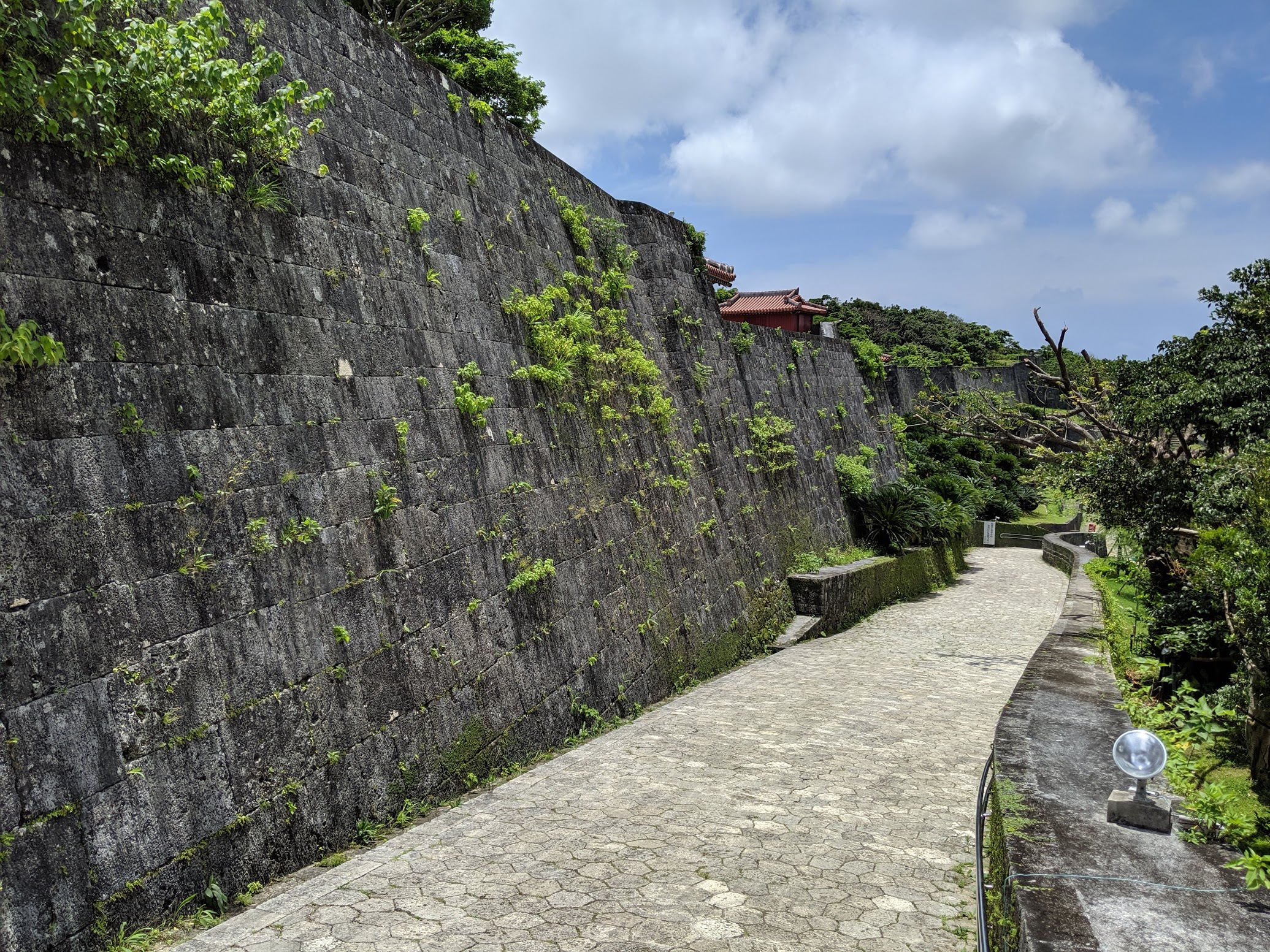
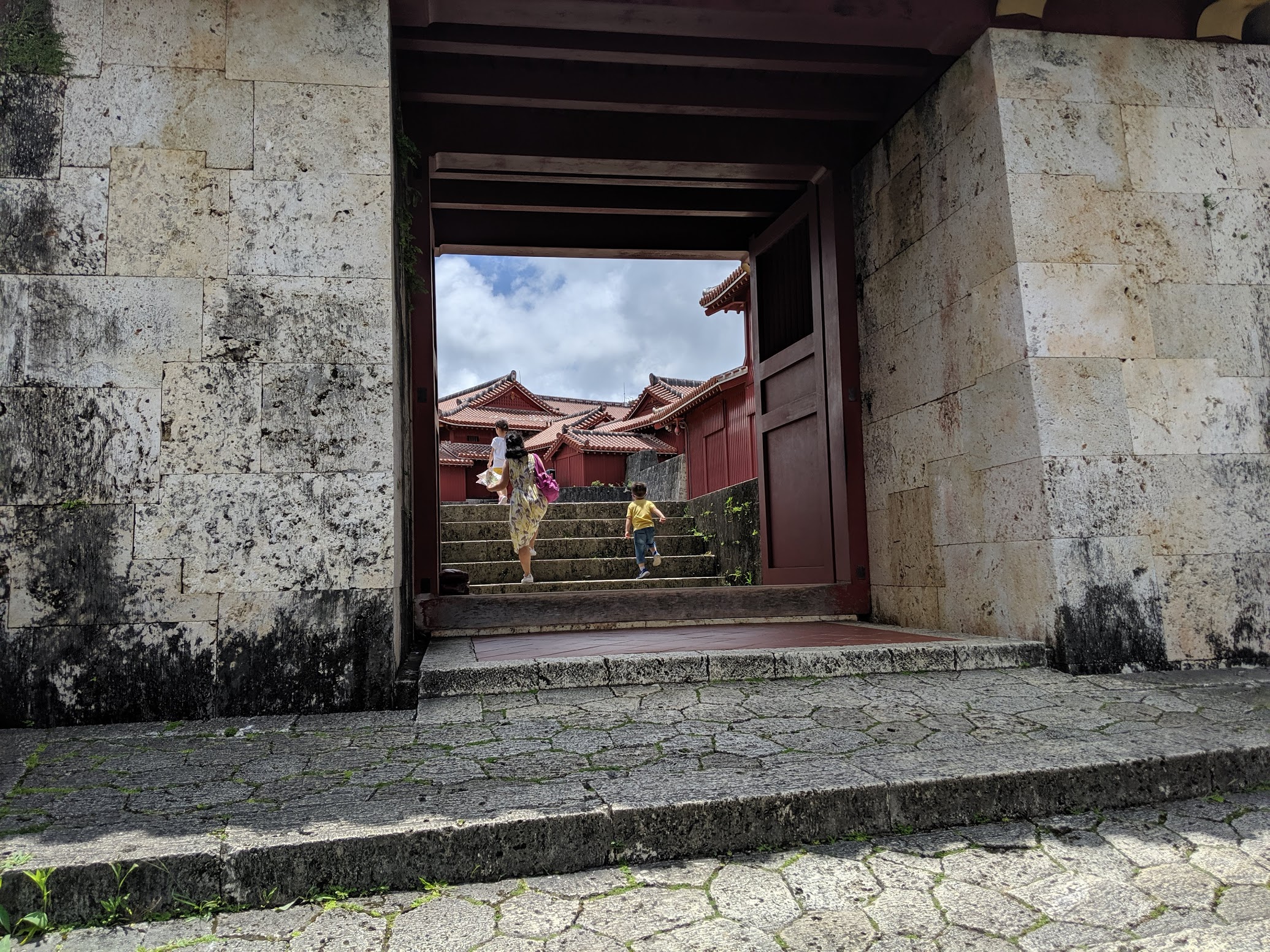
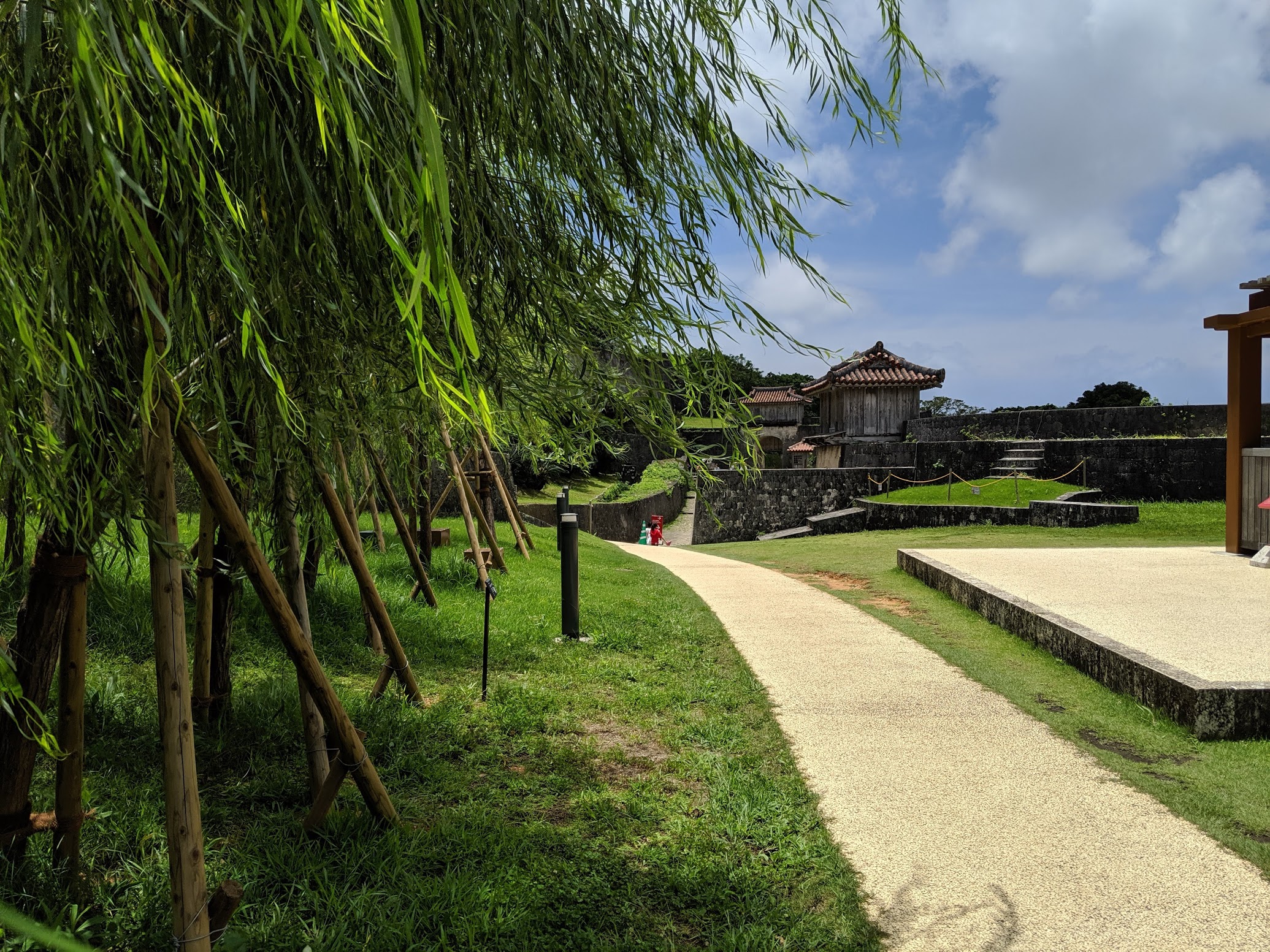
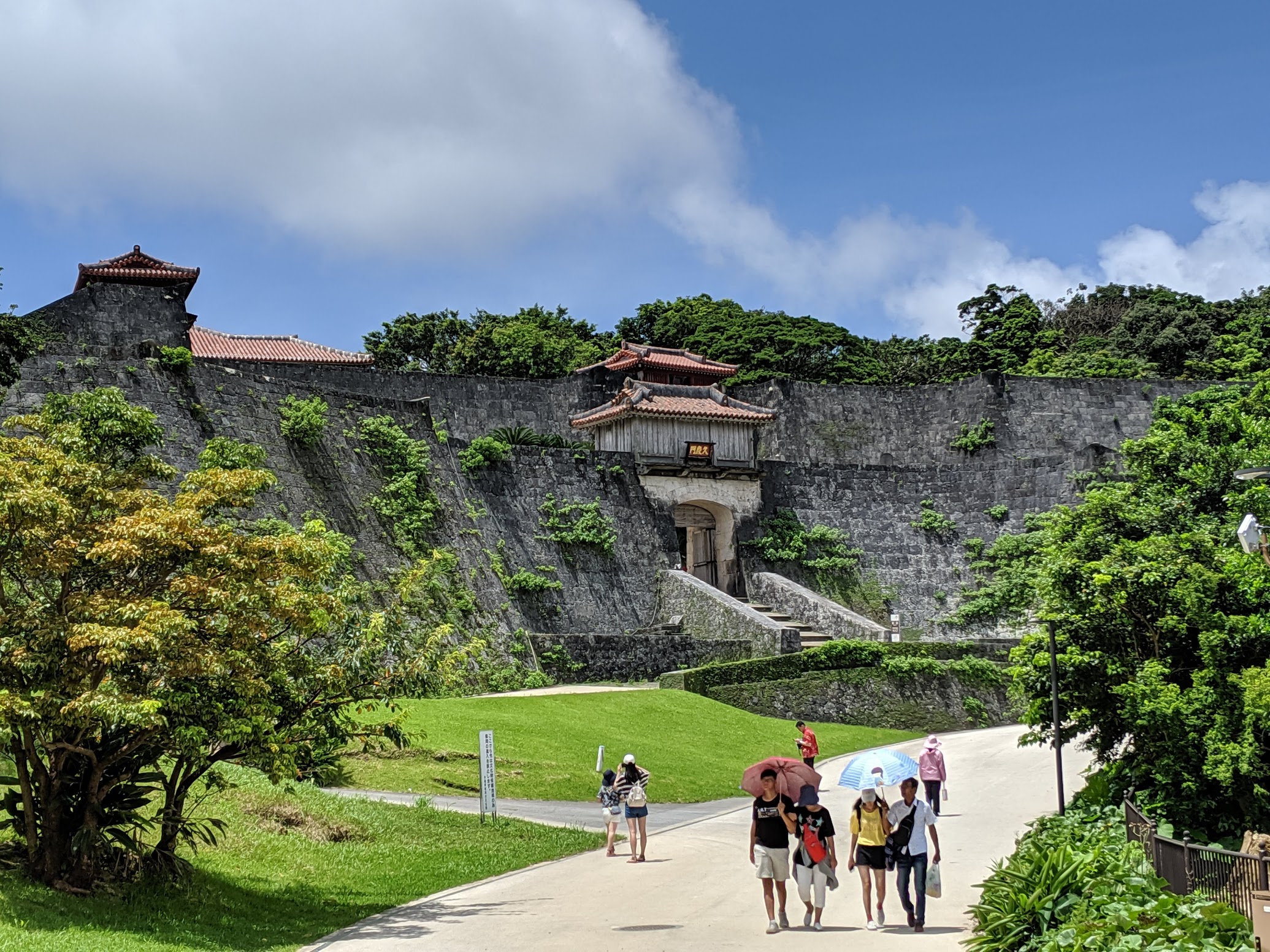
By the monorail, it took about 10 minutes to go from the Miebashi Station to the Shuri Station (首里駅), and then one walked for another 10 minute to the Shuri Castle (首里城). It was free to enter the park of World Heritage, including going into part of the castle. The route of visit was well planned, and one followed the arrow on the pervasive signs to go into Kankaimon-gate (歓会門) first. The stone walls that surrounded the castle, and the stairsteps too, were built of hexagon stone bricks, which were polished very evenly and were tightly in contact with each other. I wondered how they cut the stone bricks so precisely. The stone, except for the fern and grass in the fissure, did not appear to be so old, but definitely appeared genuine and not restored.

2.

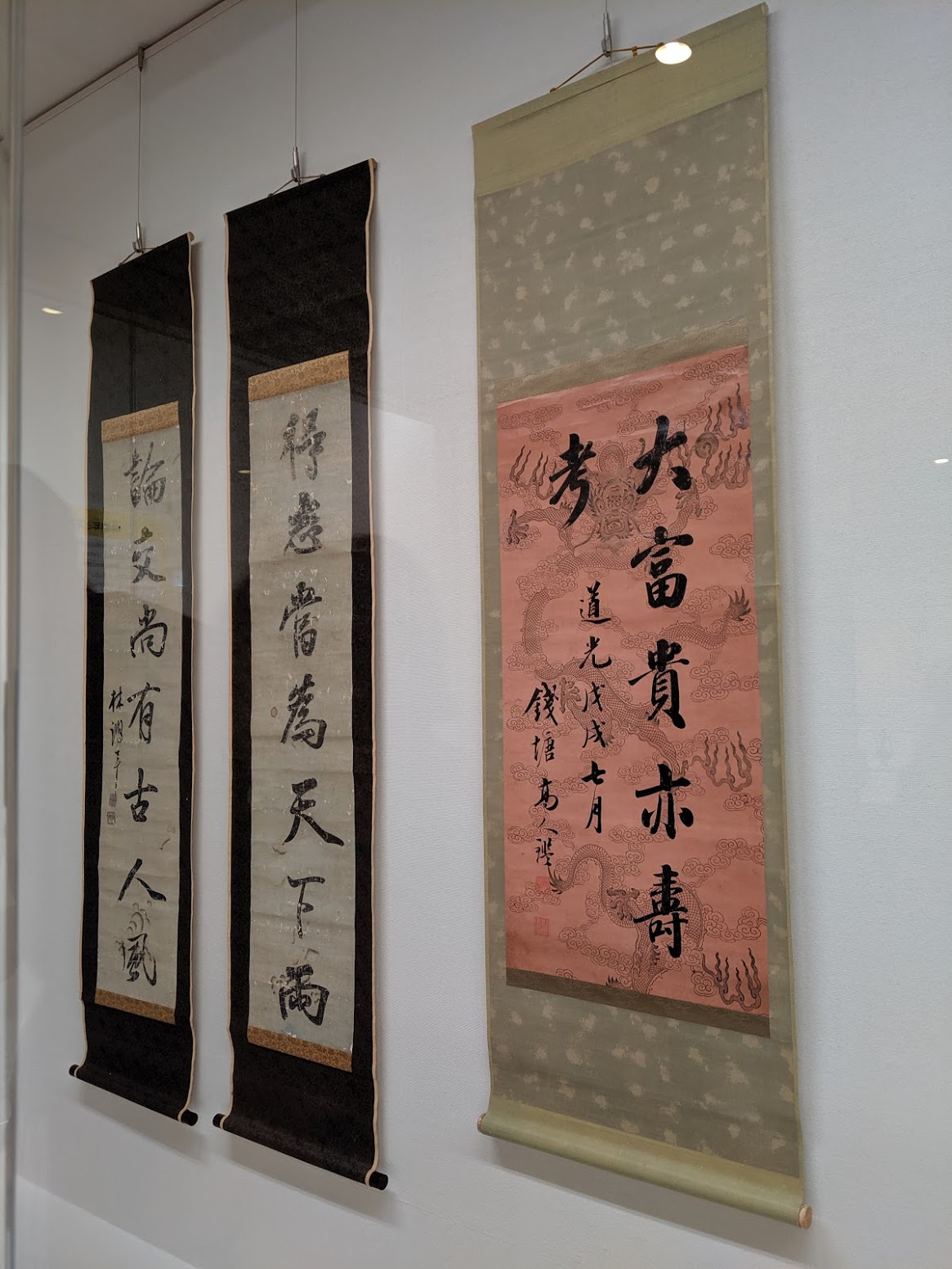
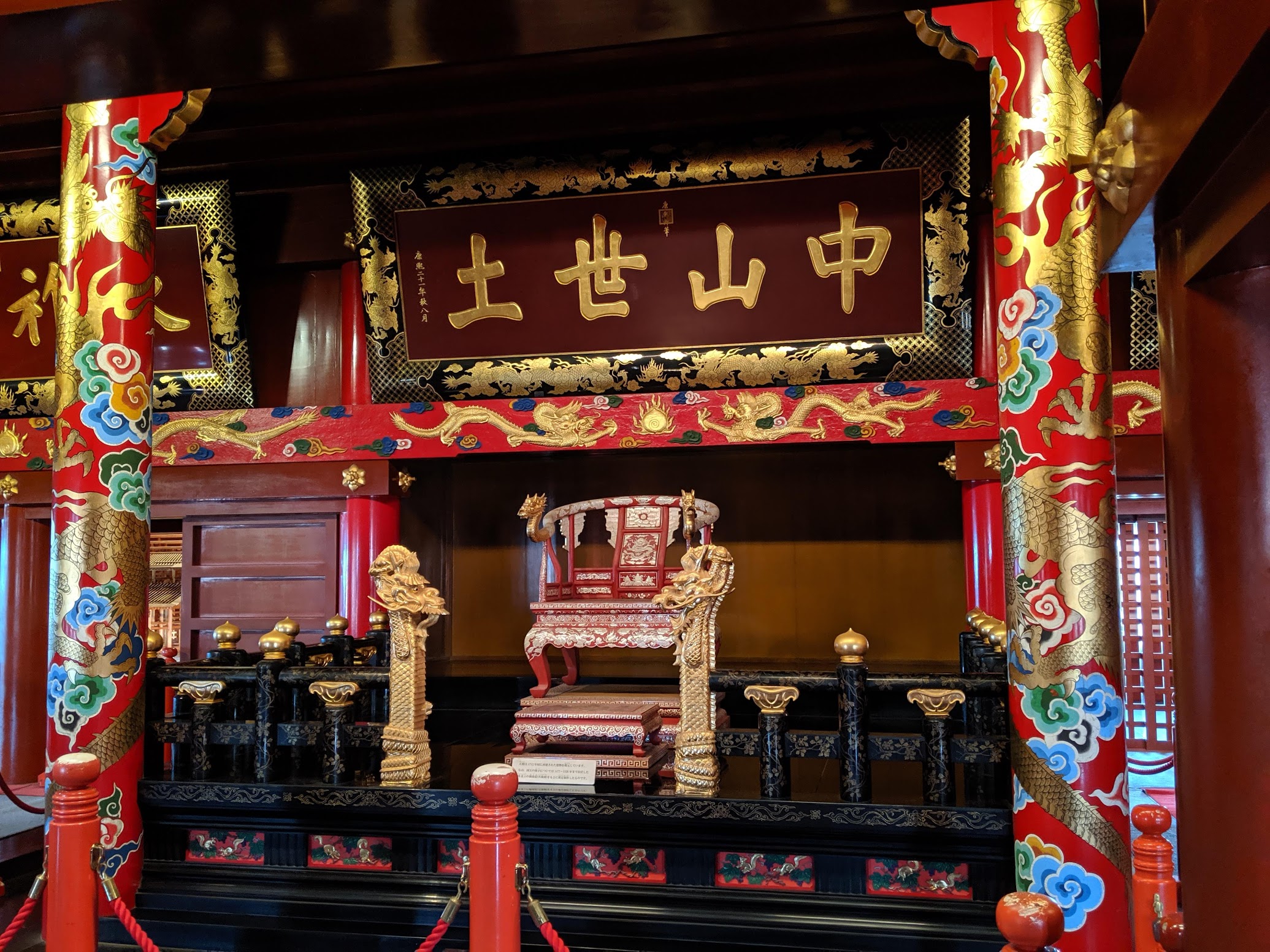
There was a gate, inside which one had to pay to visit. I was given a plastic bag (which appeared strange to me at first), and was asked to take off my shoes. Along the planned route of visit, one can see artifacts, for example a big bell’s mold, peony-carved bricks, dragon-shaped pillow remnant, the Ryukyu kings’ crown and seal, and a series of portraits of kings, all of them in the Mandarin costume. From what’s left here, the Ryukyu kings probably wrote calligraphy as skillfully as the Qing emperors. And there were the tatami-mats where the king must have sat, and looked down his people proudly. To call servants in another room, they pulled a bell, which seemed intriguing to us. These were all very interesting, but I found the stone-wall-building artistry to be most impressive above all.

3.

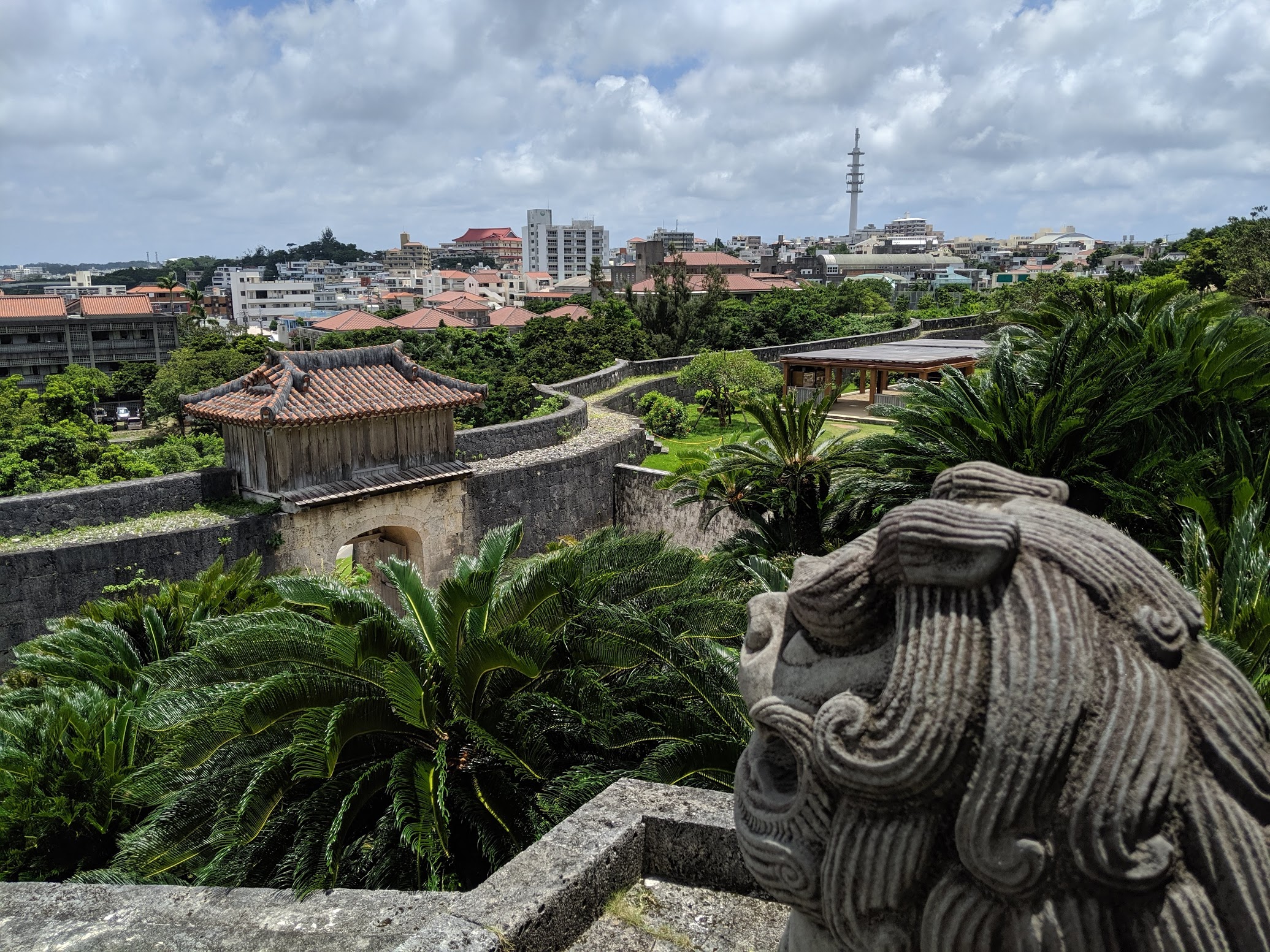
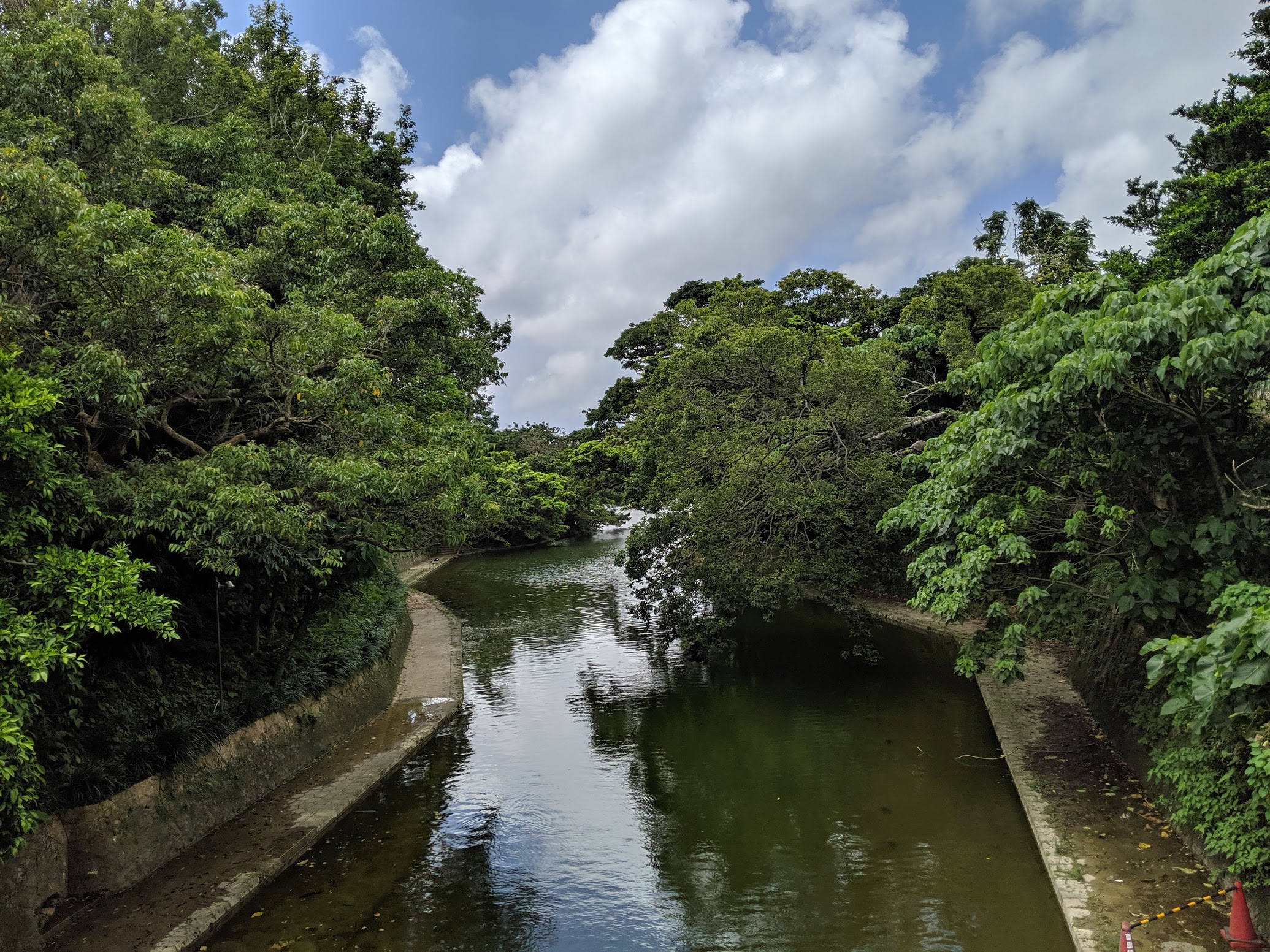
At the highest point there was an observation. One saw the China sea, the Tomari port I had been, the buildings that Naha city was, and the red roof-tiles of the palace that I was just moments ago. I left the castle, and found a wood pavilion at the center of the lake, which would have been a nice resting place if it had not been so hot. A sign explained that, in WWII, intense battles took place here, and American seized Okinawa, causing most ruin destroyed. While the Ryukyu Kingdom had once dominated the island, and in its prime vowed to serve as the port of “thousands of countries”, all that now left was a broken castle.

4.

The sentiment was all very noble, but I was hungry again. Close to the castle a restaurant called Suimui-kan (首里杜館) seemed to be the only decent place to eat. I ordered a soba-noodle, similar to what I had had in the America Village. The stewed pork often contained cartilage and fat, which I didn’t like. By the way, on the way back I helped a Thai woman — who lost her way back, could not speak English, and could not access Wifi — go to a police station. Though it would be quite a while before the flight was to took off, I chose to get to the Naha airport earlier to pick some Aloha shirts hard to see in Taiwan (or are they?).